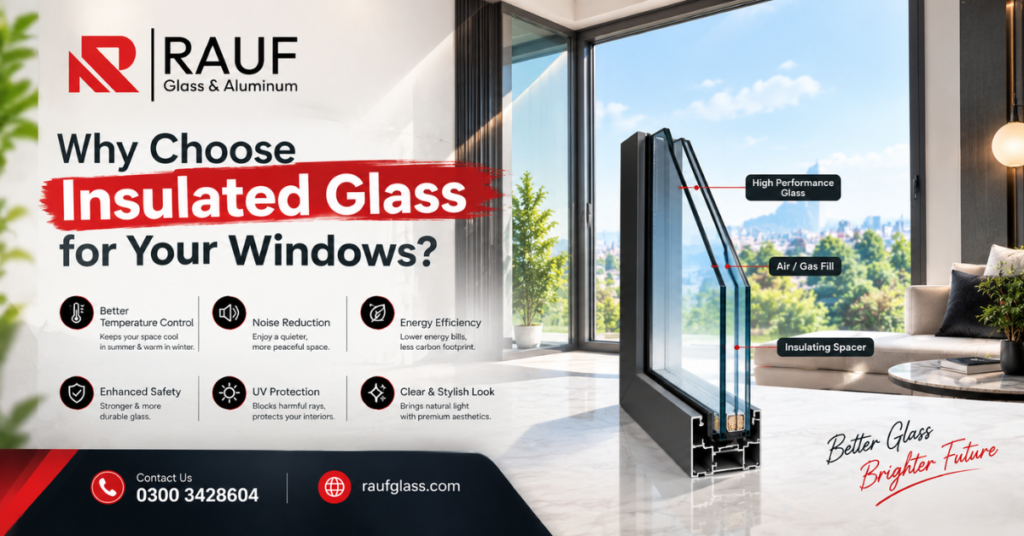
Stand next to a single-pane window on a Lahore afternoon, and you can feel the heat pushing through it. Insulated glass exists to stop exactly that. It pairs two panes of glass with a sealed gap between them. That small gap changes how a window handles heat, noise, and daily wear.
An insulated glass unit, or IGU, seals two or more glass panes together with a space between them. In fact, the gap does most of the insulating work. Manufacturers often fill it with argon, which conducts about two-thirds as much heat as air.
Rauf Glass & Aluminum Centre lists insulated glass among the core materials it works with in Lahore. This guide explains what insulated glass does and how to choose the right type for a hot climate. It also covers what to ask before you place an order.
What Is Insulated Glass?
Every insulated glass unit has four main parts. First, two glass panes face each other. Next, a spacer keeps them apart, and a desiccant inside it absorbs moisture. A sealant then locks the whole assembly airtight. TGP Systems breaks down these components in more detail.
Also, most units use glass between 3 mm and 10 mm thick. Manufacturers can build in tempered or laminated panes when a window needs extra strength or sound control.
The gap width matters too. Most sealed units reach their best insulation with a gap of about 16 to 19 mm. A wider gap lets air currents form and carry heat across, so more space is not always better.
Key Benefits of Insulated Glass for Windows
Lower Heat Gain and Smaller AC Bills
Lahore summers push air conditioners hard, and windows are often the weakest point in the wall. Single glass, for example, is a very poor insulator. The sun’s heat passes straight through it and into the room.
Insulated glass, however, slows that transfer. The sealed gap interrupts the flow of heat, and a Low-E coating adds a second layer of defence. The US Department of Energy notes that Low-E windows, especially spectrally selective ones, reduce summer heat gain and cooling costs without greatly affecting visible light.
Quieter Rooms
Traffic, generators, and street noise do not stop at your window. Insulated glass helps because two panes and an air gap dampen sound. Using different glass thicknesses on each pane improves this further, and laminated glass adds more.
More Comfortable Rooms
A hot pane radiates heat into the room even while the AC runs. In an insulated unit, the inner pane stays closer to room temperature. As a result, you feel fewer hot spots near the window, and the AC works less to compensate.
Less Fading of Furniture and Floors
Sunlight fades sofas, curtains, and wooden floors. Low-E coatings reflect part of the ultraviolet light before it enters the room. They do not stop fading completely, but they slow it down.
Stronger Protection
In addition, two panes are harder to break than one. Add tempered glass to the unit, and each pane resists impact better. If it does break, it crumbles into small, blunt pieces instead of sharp shards.
Insulated Glass vs Single Glass
| Feature | Single Glass | Insulated Glass |
| Heat insulation | Very poor | Much better, higher with argon and Low-E |
| Solar heat control | None unless coated | Low-E coatings reduce solar heat gain |
| Sound reduction | Minimal | Better, and improves with thicker or laminated panes |
| Weight and thickness | Thinner and lighter | Thicker and heavier |
| Upfront cost | Lower | Higher |
| Seal to maintain | None | Yes, since a failed seal causes fogging |
How to Choose Insulated Glass for Lahore’s Climate
Climate decides which features matter most. The Department of Energy points out that window energy savings vary by climate. A specification built for a cold country does not suit Lahore. Focus on these points instead:
- Low-E coating: Choose a spectrally selective coating. It blocks solar heat while keeping rooms bright.
- Solar heat gain: The Department of Energy treats a solar heat gain coefficient below 0.4 as low gain, which it recommends for hot climates.
- Visible light: Check that visible transmittance stays above 0.5. Lower values noticeably darken a room.
- Gas fill: Ask for argon. It insulates better than plain air at a modest extra cost.
- Spacer: Ask about a warm-edge spacer. Metal spacers conduct heat and weaken the unit’s performance.
- Frame: Pair the glass with a thermally broken aluminum frame. The Department of Energy advises that mostly metal frames need carefully integrated thermal breaks.
- Tint: Skip heavy tints. They cut heat, but they also reduce clear views and light.
What Can Go Wrong, and How to Avoid It
Insulated glass has one weak point: the edge seal. When the seal fails, moisture enters the gap and the unit fogs up. Fogging between the panes usually means the whole unit needs replacing. Units typically last 10 to 25 years, and manufacturers usually offer warranties of 10 to 20 years.
Likewise, installation matters as much as the unit itself. Poor manufacturing or installation undermines even a good IGU, because seal integrity is critical. Therefore, choose an installer who measures on site and fits the unit into a frame built to carry its weight.
Questions to Ask Before You Order
- What glass thickness does each pane use?
- Does the unit have a Low-E coating, and what is its solar heat gain value?
- Is the gap filled with argon or plain air?
- Which spacer does the unit use?
- Does the aluminum frame include a thermal break?
- How long does the warranty cover seal failure?
- Will someone visit my site to measure before quoting?
A supplier who answers these clearly is worth trusting. One who only quotes a price per square foot is not.
Why Choose Rauf Glass & Aluminum Centre
Rauf Glass & Aluminum Centre brings more than two decades of experience in glass and aluminum work to homes and businesses across Lahore. The team follows a clear process. It sends a detailed quotation, responds to your questions, visits your site, and then carries out the work within the agreed timeline.
Still deciding on a frame material? Read our guide on aluminum windows vs UPVC before you finalise your order.
You can see every glass and aluminum service on the services page. To book a site visit, contact the team at Shop G-7, Liberty Tower, Link Road, Model Town.
Final Thoughts
Overall, insulated glass is a practical upgrade for any window that faces Lahore’s heat and noise. It lowers heat gain, quiets the room, and keeps the space more comfortable. The right specification matters most. A Low-E coating, a low solar heat gain value, and a quality seal make the difference.
Finally, ask the questions above before you sign anything. Planning new windows? Contact Rauf Glass & Aluminum Centre for a site visit and a quote based on your actual openings.
📞 Call Us Today: 0300 3428604
FAQs
What is insulated glass?
Insulated glass is a sealed unit of two or more glass panes separated by a gap. The gap, often filled with argon, slows heat transfer and dampens sound.
Is insulated glass worth it in Lahore’s hot climate?
Yes, especially for air-conditioned rooms. A Low-E coating and a low solar heat gain value cut the heat that enters through the glass. That reduces the load on your AC.
How long does insulated glass last?
Units typically last 10 to 25 years. Fogging between the panes signals a failed seal, and the unit then needs replacing.
Does insulated glass reduce noise?
Yes. Two panes and an air gap dampen outside sound. Different pane thicknesses or laminated glass improve the result further.
Can I fit insulated glass into my existing frames?
Often not without changes. Insulated units are thicker than single glass, so the frame must hold the extra thickness. A site visit confirms what your frames can take.