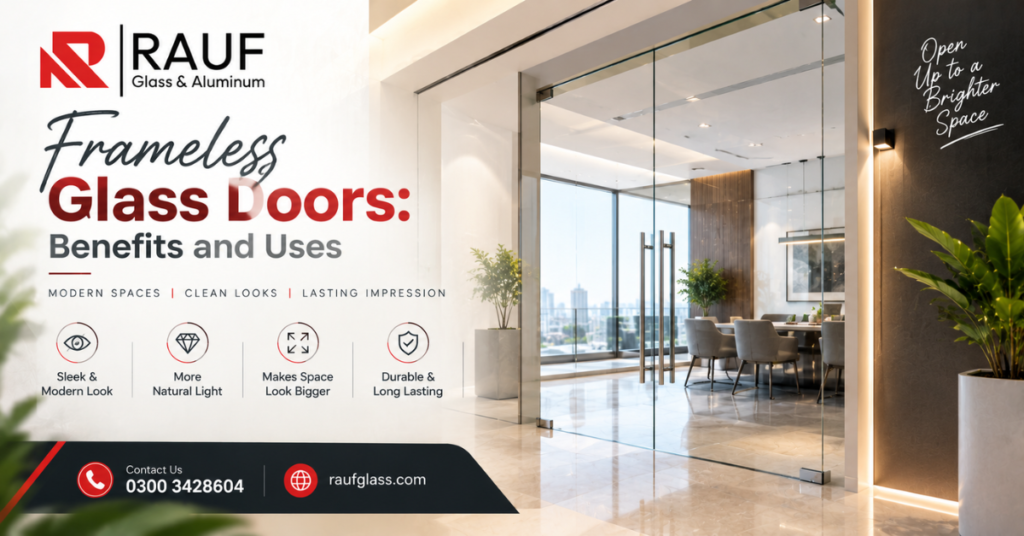
Open a frameless glass door, and the room behind it seems to open too. There are no thick frames to break the view, so light and sightlines run straight through. That is why frameless glass doors have moved from shop entrances into offices, bathrooms, and homes.
A fabricator’s design guide describes frameless glass as glass with little to no visible framing. It adds that retail shop fronts are the most common use. Homes increasingly use it too, for shower panels and balustrades.
Rauf Glass & Aluminum Centre fits glass partitions, cabins, and shower enclosures across Lahore. This guide explains how frameless glass doors work and what they offer. It also covers where they fit best and what to check before you buy.
What Are Frameless Glass Doors?
A frameless glass door uses one thick pane of glass as the door itself. Instead of a metal or wood frame, small metal fittings hold the glass at its corners. The glass carries the load, and the hardware does the quiet work.
Most frameless doors use at least 10 mm of toughened glass, and 12 mm is common for pivot doors. Tempered glass is about four times stronger than ordinary glass. When it breaks, it forms small granules instead of sharp shards.
Fabricators cut every hole and corner notch before tempering. Nobody can rework the glass afterward. Therefore, exact site measurements matter more here than with a framed door.
Key Benefits of Frameless Glass Doors
More Light and Openness
Glass lets daylight travel into the rooms behind it. A small hallway or cabin feels larger because the eye moves straight through. As a result, even a compact office feels less boxed in.
A Clean, Modern Look
Without frames, nothing competes with your interior. The fittings stay small, and they come in several finishes, including anodised, powder-coated, brass, and stainless steel. You can match them to your handles and lighting.
Strength and Safety
Toughened glass resists daily knocks far better than ordinary glass. If it does break, the small granules are less likely to cause deep cuts. In addition, full-length metal rails act as a kick plate, which lowers the chance of breakage at the bottom edge.
Easy Cleaning
Flat glass wipes clean in minutes. There are no frame grooves to trap dust, so the door looks sharp with little effort.
Choice of Glass
You can choose clear, extra-clear, grey, bronze, or acid-etched glass. Clear glass maximises the view. Acid-etched glass adds privacy while still passing light.
Types of Frameless Glass Doors
Pivot Doors
Pivot doors are the most common frameless type in both commercial and residential use. The door turns on a pivot point at the top and bottom corners. A concealed closer then brings it back to the closed position. Choose them for entrances, offices, and shower rooms.
Sliding Doors
Sliding doors save swing space, so they suit tight corridors and narrow rooms. Top-hung systems run on rollers in a ceiling track. Bottom-track systems run on a floor track instead. However, a bottom track can collect dirt and create a small step in the floor.
Bi-Fold and Stacking Doors
These doors fold or slide away to open a whole shopfront to the street. Shops can stay fully open during trading hours and lock up after closing. Cafes and showrooms use them to blur the line between inside and outside.
Frameless Shower Doors
Frameless shower doors use tempered glass at least 10 mm thick. They make a bathroom look larger and are easy to wipe down.
Where to Use Frameless Glass Doors
- Shop entrances, where the glass shows your products from the street.
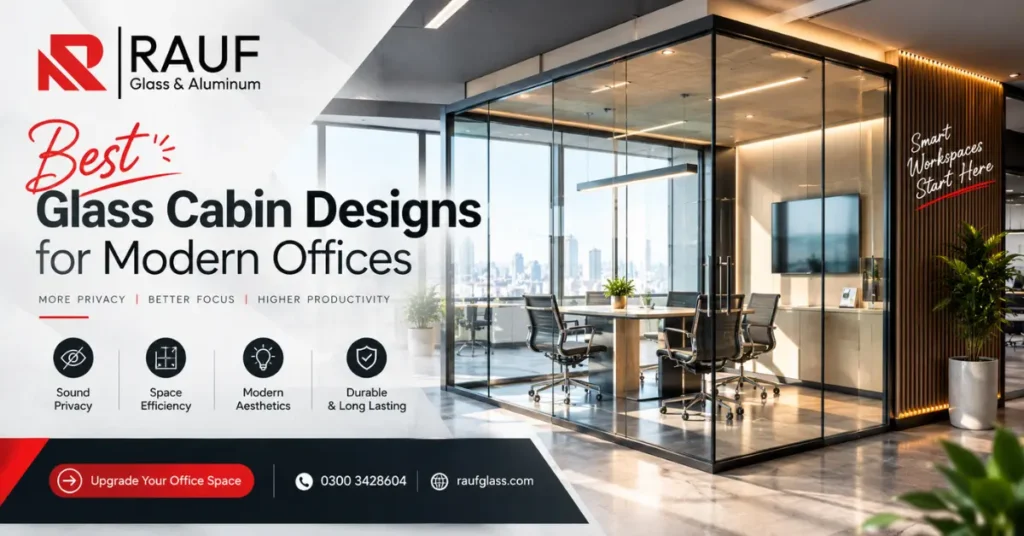
- Office cabins and meeting rooms, where daylight should reach the whole floor.
- Homes, including living rooms, balconies, and bathrooms.
- Cafes and restaurants, where bi-fold doors open the front in good weather.
- Showrooms and display cases, where a simple free pivot door is enough.
Shop owners often ask how a glass entrance fits the rest of the storefront. Our guide to glass shop front designs for modern businesses answers that.
Frameless vs Framed Glass Doors
| Feature | Frameless Glass Door | Framed Glass Door |
| Look | Minimal, almost invisible hardware | Visible frame around the glass |
| Light and views | Maximum | Slightly reduced by the frame |
| Hardware | Corner fittings, rails, or pivots | Frame holds the glass |
| Edge care | Exposed edges need careful handling | Frame protects the edges |
| Cost | Usually higher | Usually lower |
What to Check Before You Buy
First, check the glass thickness. Use 10 mm as the minimum and 12 mm for larger doors. One guide limits doors with corner patch fittings to about 2400 mm by 1000 mm in 10 mm or 12 mm glass. Bigger doors should use full-length rails, and wind load can change these limits.
Next, choose a closer. Floor springs and overhead closers stop a door from slamming or swinging open in the wind. A stronger spring suits a larger door, but it also makes the door harder to open. Balance the two for the people who use it.
Then plan a door stop for any leaf wider than 900 mm. Finally, ask about locks. A patch lock body lets you secure the door without a frame.
How Frameless Glass Doors Are Installed
Installation follows a clear order. First, the installer measures the opening on site and confirms the door size. Next, the fabricator cuts the glass, drills the holes, and tempers it. Then the team fits the corner patches and pivots. A floor spring goes inside the floor, while an overhead closer sits in a transom box above the door.
Finally, the installer adjusts the closer and checks the gaps, the lock, and the door stop. A careful final check keeps the door swinging smoothly for years.
Common Mistakes to Avoid
- Using thin glass on a busy door.
- Skipping the closer, so the door swings freely.
- Forgetting a door stop, which risks hitting the wall.
- Choosing fully clear glass where you need privacy.
- Guessing measurements instead of booking a site visit.
Why Choose Rauf Glass & Aluminum Centre
Rauf Glass & Aluminum Centre handles glass, aluminum framing, and finishing under one team. The process stays simple. The team sends a quotation, responds to your questions, visits your site, and then installs on time.
Planning new frameless glass doors? Contact the team to arrange a site visit and a quote based on your actual opening.
Final Thoughts
Frameless glass doors bring light, space, and a clean look to any building. Pivot doors suit most entrances. Sliding doors save space, and bi-fold doors open shopfronts to the street. The right glass, closer, and measurements make the difference.
Start with the door’s daily use. Then match the glass thickness and hardware to it.
📞 Call Us Today: 0300 3428604
FAQs
What thickness suits frameless glass doors?
Most frameless glass doors use tempered glass at least 10 mm thick. Pivot doors usually use 10 mm or 12 mm. Your installer will confirm the right thickness for the door size and location.
Are frameless glass doors safe?
Yes, when made from tempered glass and fitted correctly. Tempered glass is about four times stronger than ordinary glass. If it breaks, it forms small granules instead of sharp shards.
Can frameless glass doors be used outside?
Yes. Many shopfronts use them. External doors face wind, so the installer must design the glass thickness and fittings for that load.
Do frameless glass doors give privacy?
They can. Acid-etched or frosted glass blocks clear views while still letting light through. You can also add blinds where you need flexible privacy.
How much do frameless glass doors cost?
Cost depends on glass thickness, size, hardware, and finish. Frameless doors usually cost more than framed ones because of the thick glass and fittings. A site visit gives you an accurate quote.